


A psychologist who works frequently with those who have hearing loss once lamented that the term hearing loss should be replaced with the term communication loss. The thought was expressed only whimsically, as he knew the term hearing loss is far too ingrained within our lexicon to ever disappear. But his thought highlights a fundamental problem: The term hearing loss places the blame for faulty communication on the one with the loss, while communication loss reflects the reality that when clear communication does not exist, the responsibility to improve the exchange lies with both parties.
As Helen Keller so aptly put it: “Alone we can do so little; together we can do so much.” Yet, when a communication partner does not do their part to ensure smooth conversation, how many times can we ask for what is needed?
I once had a hearing aid user in my office who told me, “I often tell people, I promise not to get upset when you forget to speak more slowly (or more clearly or while facing me or when in the same room with me, etc.) if you promise not to get upset when I remind you repeatedly that I need you to speak more slowly (or more clearly or while facing me or when in the same room with me, etc.).” He noted that while his communication partners would often simply chuckle at his statement, he knew his message was heard and that the stage had been set.
Even when using directives like the above, it is not easy for everyone to assert their needs. Dr. Brené Brown, the renowned vulnerability researcher, gives one reason that this is true. As she has written, “Fitting in is the greatest barrier to belonging.” Research has demonstrated that humans adjust their actions to be more aligned with that of their peers in an ongoing effort to not stand out from the group; to not be perceived as different.
When those with hearing loss make an effort to improve hearing beyond the limitations of what technology can provide (e.g., hearing aids and other hearing assistive technologies), they find they need to set themselves apart from others. They need to draw attention to their difference. They need to discuss their hearing loss. They need to tell others what they need them to do. They need to step outside the comfort of conformity, which, by our very nature, we find difficult.
Imagine the Following Conversation Between a Hearing Consumer and His Audiologist
Mr. Andrews confides in his audiologist that he is considering leaving his ROMEO group. Seeing his audiologist’s quizzical expression, he adds, “You don’t know what that is, do you, Doc?”
He explains that ROMEO stands for Retired Old Men Eat Out and that as much as he looks forward to these once-a-month gatherings, in recent months, he finds he anticipates them with at least an equal amount of dread. As he explains to his audiologist, “What makes lunches like this enjoyable is a combination of good food and good company. I’m finding that as my hearing gets worse, I’m losing that good company – even with my hearing aids. I strain too much to follow these group conversations; others will laugh, and I’ll have no idea what the joke was, and I leave the lunch frustrated and exhausted. It’s just becoming too much.”
“Well, I suspect these lunches have been something important to you and that this decision is one you aren’t making lightly. May I make a suggestion?” After a nod, the audiologist continues with the following:
“Perhaps you could start lunch by saying, You all know I have trouble hearing sometimes. What you might not know is that I’ve been missing a lot of our conversations. So that I don’t need to interrupt all the time, asking for repetitions when I miss something, I want to show you two signs. This means to slow down for me (pumping an open hand, palm downward), and this means to speak just a bit louder (palm upwards and moved slightly up and down). I know you guys probably know I sometimes need these things, but I’m sure if I were you, I wouldn’t always remember. Is it OK if I use those signs when I need them?”
The audiologist concludes with, “What do you think, Mr. Andrews? Is that something you would be comfortable doing?”
Mr. Andrews gives a warm smile and chuckles softly. “No, I don’t think I could do that. It’s a bit too much.”
“Well, perhaps,” the audiologist says. “But are you willing to stop going to your lunches without giving it a try? What do you think the group would say if you said all this?”
“I don’t know,” he reflects softly.
“Well, I suppose none of us really know until you try it. But I suspect they’ll look at you a little funny, shrug their shoulders, and say, ‘Sure, why not?’ I think they’ll see the benefits of the suggestion. Besides, what’s the worst thing they could do, ask you to stop coming to the group? Then you’d be right where you are now, so you wouldn’t have lost anything. And do you think they would do that? Would you do that to one of them?”
Asserting our communication needs, as the audiologist in the above example is encouraging Mr. Andrews to do, can feel uncomfortable for many. A key to making such assertions is to question what the outcome would be if we did declare our needs. Our perceptions of how others might react are often not reality. If we reflect on what the result would be if our most dreaded envisioned scenario should unfold following our request, we can often see that such scenarios are unlikely and survivable.
As Dr. Brené Brown has noted, one of the driving forces behind living with any handicap is trying not to draw attention to the handicap or how the individual is different from others. But we can overcome this limitation. We can give ourselves permission to assert our needs in a conversation. Often, this can be done in a nonintrusive manner that leads to more successful communication.
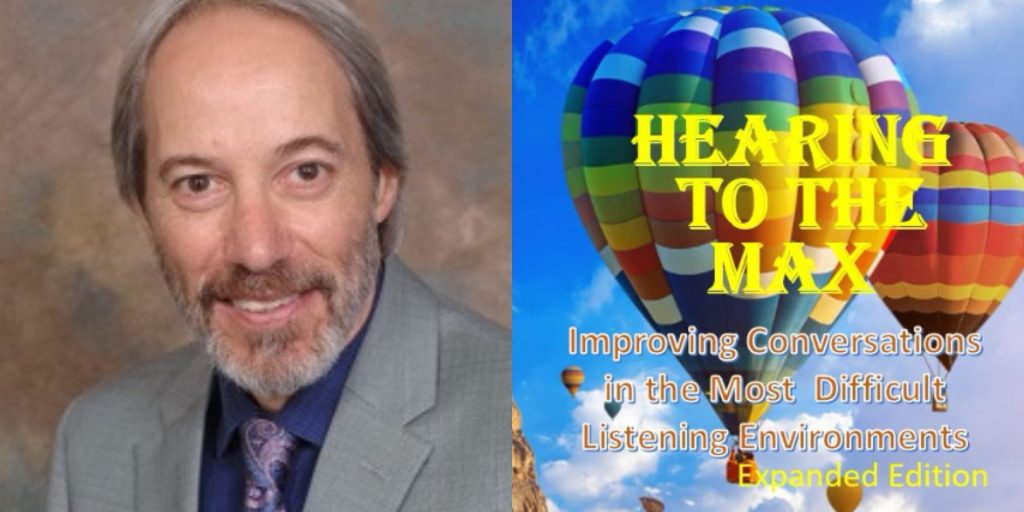
In a new consumer guide, Hearing to the Max, available on Amazon, some sections like “No more ROMEO,” “My Son-In-Law Hates Me,” and “The Talking Stick” guide readers through a variety of strategies to improve communication effectiveness. They also highlight the important introspection often required to assert one’s needs better. In addition, Hearing to the Max includes step-by-step guidance on how to make communication management techniques a life-long habit, which can go a long way in decreasing the frustrations, brewing anger, resentment, and frequent arguments that sometimes come with poor communication habits.


Will mastering better communication skills and embracing greater assertions of your communication needs solve all your hearing challenges? Undoubtedly not. But it will lead to greater success—not perfection—but communication with less stress, less frustration, and greater joy.

John Greer Clark, Ph.D., is a professor of audiology at the University of Cincinnati, and former faculty fellow of the Ida Institute in Naerum, Denmark. He currently serves as the Director of Audiology Education. With a lengthy history in private practice, he has served on the board of directors for the American Academy of Audiology and the Ohio Academy of Audiology, is a past Chair of the American Board of Audiology, and a past president of the Academy of Rehabilitative Audiology. Clark has authored/co-authored/co-edited 17 books and instructional CD-ROMS on hearing loss and hearing help, numerous book chapters, and a variety of peer-reviewed and invited articles on various aspects of communication disorders. His research interests are in adult audiologic rehabilitation, patient and family counseling relative to hearing loss management and animal audiology.