


Do you experience a constant sound or noise, such as ringing, hissing, buzzing, etc., in your ears? If the answer is yes, you might be suffering from tinnitus. Tinnitus is an underlying condition wherein an individual can constantly hear some noise without any external source. This noise or sound can be anything, such as ringing, chirping, hissing, buzzing, humming, or roaring. While there is no cure for chronic tinnitus, tinnitus sound generators can help manage the condition.
Through this article, I aim to educate you on choosing the best tinnitus sound generator to manage the condition of tinnitus. Before I do that, let me first introduce you to tinnitus and its impact on individuals.
What is Tinnitus? How Does it Affect?

Tinnitus is a common condition where you constantly hear different sounds or noises, especially the ringing sound. If you have tinnitus and hear sound constantly, it is not because of any external source; hence, other people can’t hear it.
Multiple health conditions are responsible for the occurrence of tinnitus. These include hearing loss, ear infection, ear canal blockage, head or neck injuries, and certain medications (nonsteroidal anti-inflammatory drugs (NSAIDs), cancer drugs, antimalarial drugs, and antidepressants).
Many people’s tinnitus improves when their underlying disease is addressed and treated well. On the other hand, some people can be negatively impacted, affecting their overall quality of life.
Unfortunately, tinnitus is incurable in some people. However, a few strategies can help manage the condition and make symptoms less noticeable. Some of these strategies include:
- Using a tinnitus sound generator
- Using hearing aids
- Earwax removal
- Diet and lifestyle modifications
- Sound therapy
Sound Therapy for Tinnitus
Sound therapy is one of the most adopted strategies for tinnitus. A study suggests that many sound therapies show positive therapeutic effects. It leverages external sound or noise to treat tinnitus.
Masking and habituation are two common, widely adopted sound therapies. Let us discuss them in detail below.
Masking
As the name suggests, masking involves exposing an individual to background noise, such as white noise, nature sounds, or ambient sounds. Doing this masks the tinnitus sound and drives an individual’s attention to other sounds.
External sounds or music through sound machines, headphones, or other devices can help break tinnitus sound for a short time. Also, the sound of an electric fan, TV, or radio can work.
Habituation
Another sound therapy for tinnitus is habituation. It involves training your brain to become more familiar with the tinnitus sound you hear. The therapy requires you to listen to the same tinnitus sound for a long period so that your brain starts ignoring it. However, this therapy is carried out by a specialist, and the time frame for tinnitus sound exposure varies from person to person (usually 12 to 24 months).
What is a Tinnitus Sound Generator?
A tinnitus sound generator is an electronic device used to provide relief to people suffering from tinnitus. It generates a sound called white noise or pink noise that partially covers up or masks the tinnitus sound. This sound can be adjusted in terms of pitch, frequency, and volume to adjust to an individual’s needs and preferences.
Tinnitus sound generators are available either as standalone devices or are included in hearing aids. Like hearing aids, these generators are also available in a variety of shapes and sizes.
A tinnitus sound generator is usually worn behind the ear and comes with a speaker that sits inside the ear canal. The speaker, which is very small, is attached to the device (that sits behind the ear) with a thin wire. It fits well inside the ear canal while preventing the plugged-up sensation for users.
Types of Tinnitus Generators
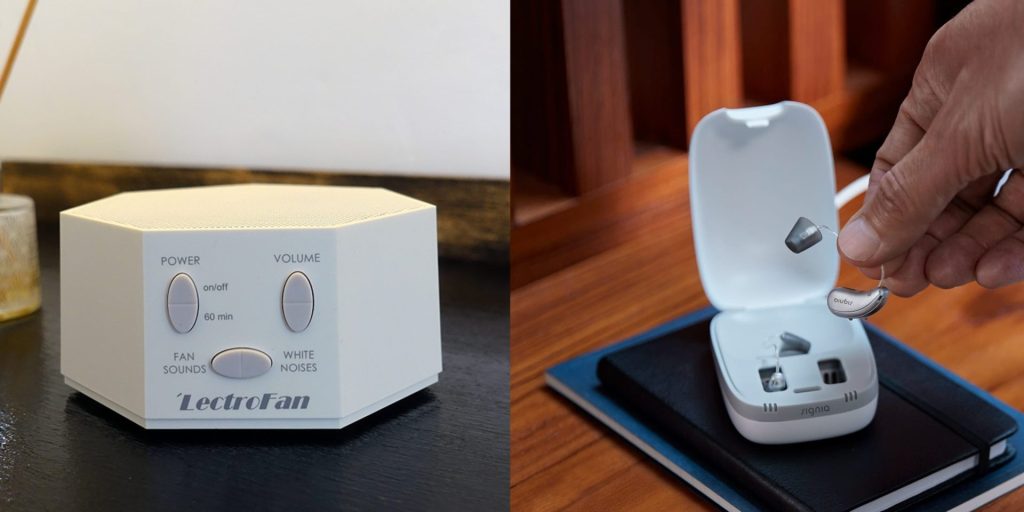
Here are some different types of tinnitus generators available on the market:
Tabletop Sound Generators
As the name suggests, tabletop sound generators are specially designed to be placed on tables, shelves, and any other surfaces, especially bedside units. They emit the sounds of rainfall, wind, birds, heartbeats, and other natural sounds, distracting you from the tinnitus sound.
Tabletop generators are available either as battery-powered or rechargeable. You can easily adjust the volume and set a timer so that it automatically turns off when you fall asleep. Also, you can keep them on throughout the night to prevent a ringing sound in the morning.


Wearable Sound Generators
Unlike tabletop sound generators, wearable sound generators are designed to sit inside the ear canal or behind the ear. They are more similar to hearing aids. They generate white noise to block the tinnitus sound and are generally battery-powered.
Wearable sound generators are small, subtle, and invisible. However, the cost is very high compared to tabletop sound generators. While tabletop sound generators cost $25 to $80, wearable sound generators are available for around $250. The reason for the high cost is its ease of use in your everyday life.
Hearing Aids
Hearing aids can also help provide relief from the constant internal ringing in the ears due to tinnitus. Tinnitus also comes with some degree of hearing loss. As a result, hearing aids help improve sound clarity, allowing you to make clear conversations without hesitation.
Difference Between White Noise, Brown Noise, Pink Noise
When you are trying to find a tinnitus sound generator, it is important for you to understand the difference between white noise, brown noise, and pink noise. Let us debunk it in this section.
White Noise
White noise is a sound made up of equal intensity across a broad spectrum of frequencies within an audible range. It contains low, middle, and high-frequency sounds.
White noise is ideal for sound masking, improving concentration, and relaxation. It is basically a hissing sound, which has a flat frequency response. You can think of white noise as the sound of a waterfall, which falls at different speeds and hits different surfaces.
Pink Noise
Like white noise, pink noise also has a steady or constant background hum, which filters out sounds that distract you. It is a sound with a consistent intensity decrease of -3 dB per octave as the frequency increases. It leverages deeper sounds and lower sound waves, providing a smoother and more gentle experience.
Moreover, pink noise has a lower pitch and uses a consistent frequency to create flat sounds, like waves on the beach, steady rain, etc. It has a more natural and balanced tonal quality.
Brown Noise
Brown noise, also known as red noise, is a sound whose sound level decreases as the frequency rises. It generates a deeper bass-like tone, similar to a steady heavy rainfall and a shower with high pressure. It has more sound intensity at lower frequencies and lower sound intensity at higher frequencies.
Choosing the Right Tinnitus Sound Generator for You
Here are some factors to consider while choosing the right tinnitus sound generator for you:
- Consult a Hearing Healthcare Professional
Before you decide on a tinnitus sound generator, it is always better to visit a hearing healthcare professional to assess your tinnitus symptoms. Based on your symptoms, they can recommend a more suitable device that can effectively mask the perception of tinnitus. - Type of a Sound Generator
As we have already discussed different types of sound generators above, it is a considerable factor. Choose the type based on your lifestyle and preference. Remember to choose one that is more convenient for you. - Adjustable Volume
Ensure that you select a device that lets you adjust the volume level according to your comfort. If the volume is too loud or too low, it would not be effective for managing tinnitus. - Portability
If you have an active lifestyle, the portability of a sound generator matters a lot. In this case, you must consider wearable sound generators or hearing aids with tinnitus management features. - Battery Life
The battery life matters a lot if you want to use the sound generator throughout the day. Some sound generators use disposable batteries, while others use rechargeable batteries. - Masking and Relaxation Features
Masking and relaxation features are a must. Masking technology covers up the tinnitus sound, and the relaxation feature generates a sound that creates a soothing and calm environment. - Cost
Determine your budget and look for the options. Tabletop sound generators are less expensive than wearable sound generators. If you choose hearing aids with tinnitus management features, the cost is even higher than that of wearable masking devices. On the other hand, smartphone apps are more affordable options.
Pros and Cons of Sound Generators
The following is a list of some of the major benefits and drawbacks of sound generators for tinnitus:
Pros
- Relief: Provide relief from tinnitus by producing background sounds, such as white noise or pink noise, and masking the perceived tinnitus sounds.
- Improved Sleep: Tabletop sound generators ensure improved sleep quality by producing soothing sounds.
- More Concentration: Individuals can concentrate on their daily work and improve their productivity as sound generators mask persistent tinnitus sounds.
- Portable: Sound generators, like wearable devices, are portable, small, and discrete. They are virtually invisible.
- Non-Invasive: Sound generators are non-invasive, as you won’t experience any pain while wearing them. They are very gentle, and you can take them off whenever you want.
- Speech Understanding: Chronic tinnitus can result in dysfunctional central auditory processing and hearing loss. This affects your ability to understand speech clearly. Hearing aids with tinnitus management features help improve speech comprehension.
Cons
- Price: Wearable sound generators and hearing aids with tinnitus management features are highly expensive, and the cost outweighs the features and benefits.
- Sound Sensitivity: If you are sensitive to a sound, you may find using a tinnitus sound generator a sound-intensifying feature uncomfortable.
- Insurance Coverage: It is hard to get financial aid for sound generators.
Hearing Aid or Sound Generator Devices
Hearing aids are electronic devices that amplify sounds, allowing people with hearing impairment to hear properly with improved quality. On the other hand, tinnitus sound generators are devices that produce sounds to suppress the tinnitus sound.
However, some hearing aids have built-in features to reduce the perception of tinnitus. They are considered combination devices, as they combine the features of hearing aids and tinnitus sound generators. Though tinnitus patients with hearing loss use these combination devices, they are suited for normal people as well.
More interestingly, tinnitus patients with normal hearing use these combination devices by turning off the amplification feature.
Another major difference between hearing aids and sound generators is that the former has Bluetooth streaming capabilities. Hence, they are more expensive than sound generators.
Eventually, the best option is to consult a hearing healthcare professional to determine which device works best for your hearing needs and manage tinnitus.
Conclusion
Sound generators for tinnitus are among the effective solutions for managing tinnitus. They mask the tinnitus sound by producing other soothing and calm sounds, improving an individual’s hearing quality. Many studies suggest that people with tinnitus using sound-generation devices have experienced improved quality of sleep.
As a variety of tinnitus sound generators are available out there, it can be overwhelming to choose the right one. Before considering any factors, ensure that you consult a hearing healthcare professional. They suggest the right devices based on your tinnitus symptoms.

Florida License: AS-2471 – NPI: 1992749147
Ivonne Baixeras is a Florida-Licensed Hearing Instrument Specialist with a track record of almost three decades treating hearing problems in Miami-Dade County and serving the needs of thousands of satisfied patients. Ivonne is a graduate of both Miami-Dade College & Florida International University and worked for many years at the largest national chain of hearing clinics in the US where she's received multiple awards.