


Do you love listening to your favorite music playlist or enjoy new tracks? If yes, you probably might use headphones to experience the pleasant nodes and meaningful lyrics of music. However, what if you use hearing aids? It seems daunting, right?
Many wearers think that wearing headphones with hearing aids is pretty challenging. Well, this is not the case, thanks to technological advancements in the hearing aid landscape. You can enjoy your favorite tracks with headphones while wearing auditory aids.
Hearing aids have come a long way over the past decade. They have evolved in terms of both design and technology. Modern hearing aids have a discreet design, offer extreme comfort, and are equipped with features such as Bluetooth connectivity, directional microphones, feedback cancellation, and smartphone app compatibility.
The discreet design of today’s hearing aids has made it possible to wear headphones with them. This blog post is a comprehensive guide on how to wear headphones with hearing aids. It also covers the types of hearing aids that work best with headphones.
Bluetooth-Enabled Hearing Aids
Bluetooth-enabled hearing aids are the best options to choose from. With these devices, you can stream audio directly to your hearing aids without using any headphones!
These hearing aids connect seamlessly to your smartphone, iPod, tablet, MP3 Player, and other devices via Bluetooth and stream sound. You can easily control volume levels and play songs of your choice effortlessly. However, it is important to check beforehand what different devices your Bluetooth-enabled hearing aids support.
If your hearing aids do not have Bluetooth connectivity, you need to consider some specific styles of hearing aids.
Which Types of Hearing Aids Work Best with Headphones?
Hearing aids are available in different styles. Hence, it becomes challenging to choose one that best fits your headphones.
If your hearing aids do not go well with your headphones, they get pressed against each other, resulting in reduced sound quality and the introduction of feedback. The standard distance between the microphones of hearing aids and headphones is 1 cm. If the distance is larger than the standard one, it would not be possible for headphones to direct sound to your hearing aids.
The following are the styles of hearing aids that work best with headphones:
BTE Hearing Aids
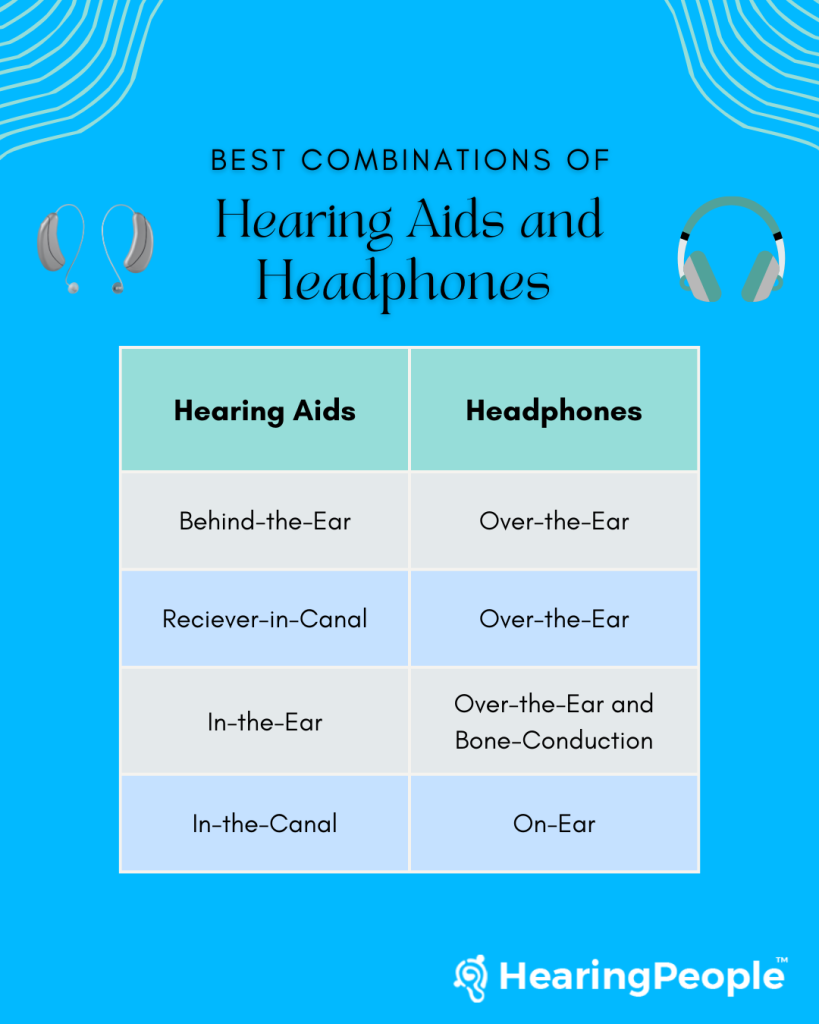
BTE stands for Behind-the-Ear. As the name suggests, these auditory aids sit behind the ears. A thin tube connects the hearing aid to the custom earpiece called an earmold that fits inside the ear canal. The over-the-ear headphones suit best for BTE hearing aids.
These auditory aids are available in different sizes, such as mini BTEs with extremely thin tubing. They are ideal for all levels of hearing loss, from moderate to profound.
RIC Hearing Aids
RIC is an acronym for Receiver-in-Canal, a type of BTE hearing aid. It has a speaker or receiver inside the ear mold and not in the hearing aid’s body. Also, it leverages a thin wire rather than tubing to connect the hearing aids to the ear mold in the ear canal. Over-the-ear headphones go best with RIC hearing aids.
When choosing BTE or RIC hearing aids, it is important to choose headphones that entirely cover your hearing aids’ microphones located behind the ear. However, if your headphones fail to cover microphones, hearing aids pick external sounds other than the ones coming from headphones.
ITE Hearing Aids
In-the-ear (ITE) hearing aids, as the name implies, fit inside the ear. They are available in two different styles – one that covers most of your outer ear’s bowl-shaped area and the other that covers only the lower part of your outer ear.
These devices are suitable for people with mild to severe hearing loss. They suit best for over-the-ear and bone-conduction headphones.
ITC Hearing Aids
In-the-Canal hearing aids are custom-fitted and fit in the lower portion of your outer ear bowl. Additionally, they are a bit larger than Invisible-in-the-canal (IIC) and completely-in-the-Canal (CIC) hearing aids. Hence, ITC hearing aids have batteries that last slightly longer. They can address a wide range of hearing loss and are suitable with on-ear headphones.
Best Combinations of Hearing Aids and Headphones
Types of Headphones
Like hearing aids, headphones are available in different styles. They are as follows:

- Over-the-Ear Headphones
As the name suggests, over-the-ear headphones sit over the ear and top of the head. They are known as circumaural headphones and are commonly used. With large ear cups covering entire ears, these headphones offer a better noise-cancellation feature. Glass wearers can comfortably use over-ear headphones as the ear cups are pressed around the ears and not exactly ears.
Over-ear headphones work best with almost every type of hearing aid.
On-Ear Headphones
On-ear headphones rest on top of the ears over the head. Though they resemble over-the-ear headphones, they are smaller in size and rest perfectly over the ears. As they do not completely cover the ears, there is a chance for external sounds to come in and go out. Hence, these headphones might not work for you if you are concerned with sound isolation.
These headphones are suitable for people using receiver-in-canal (RIC) auditory aids.
- Bone-Conduction
Bone-conduction headphones are quite different from all other types. Neither do they sit inside your ear canal like earbuds, nor do they sit over or on the ears. They work by sending sound waves from the skull rather than the eardrum. They direct the sound to the cochlea, reducing the stress on the eardrum. Hence, you can hear clearly what you are listening to.
They work best with in-the-ear (ITE) and in-the-canal (ITC) hearing aids.
- Earbuds
Earbuds sit inside the ears and just outside the ear canal. Hence, they mostly interfere with hearing aids.
5 Best Headphones for Hearing Aids
Let us now dive deeper into the list of the best headphones for hearing aids and know their features.
Shokz OpenMove
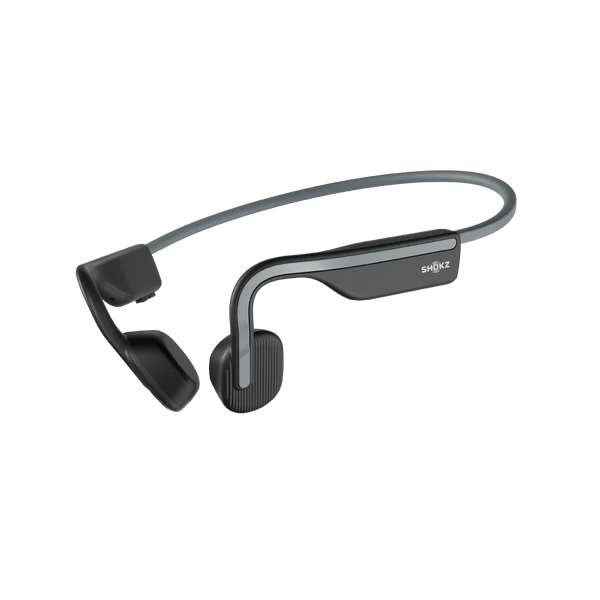

Best With: In-the-ear (ITE), in-the-canal (ITC), completely-in-canal (CIC), and invisible-in-canal (IIC)
Battery Life: 6 hours
These are bone-conduction, open-ear headphones from Shokz. Ideal for everyday use, they are versatile and equipped with the best-in-class 7th-generation bone-conduction technology. They are highly comfortable and offer safe listening at an affordable price.
The open-air design of these headphones allows your ears to breathe and have an awareness of the surroundings. Powered with cutting-edge technology, PremiumPitch 2.0, and 7th-generation bone-conduction technology, the transducers offer precise and balanced audio, rich bass, and optimal volume.
Moreover, OpenMove headphones are IP55-rated and are resistant to dust, sweat, rain, and snow. They are extremely lightweight, i.e., 29 grams, providing all-day comfort. The Bluetooth connectivity supports a wireless range of up to 10 meters.
Sennheiser RS 135 On-Ear Wireless RF Headphones

Best With: Completely-in-canal (CIC) and invisible-in-canal (IIC)
Battery Life: 20 hours
Sennheiser RS 135 are lightweight, on-ear headphones that come with a charging cradle and connect with analog devices. These wireless radio frequency (RF) headphones are ideal for watching TV shows and movies. Hence, you can get rid of cumbersome cables.
Also, recharging the headphones is straightforward. Simply put headphones on the transmitter base station (charging cradle), and they will automatically charge. Setting up these headphones is also an easy task. Simply plug the transmitter in and connect the audio to the analog output.
Sennheiser RS 135 headphones have an Open-Aire design for high-fidelity audio reproduction. It features a three-position channel selector, allowing you to choose an interference-free channel for clear reception. The major setback of these headphones is they lack Bluetooth connectivity.
Recon 70 Blue Camo Headset

Best With: In-the-ear (ITE), in-the-canal (ITC), behind-the-ear (BTE), completely-in-canal (CIC), and invisible-in-canal (IIC)
Recon 70 Blue Camo Headset from Turtle Beach is a multi-platform gaming headset. You can use this headset with different gaming consoles, including Xbox One & Xbox Series X|S, PS4 Pro, PS4, PS5, and Nintendo Switch.
These over-ear headphones are lightweight and comfortable, allowing you to play games for hours uninterrupted. They feature Turtle Beach’s Flip Up mic, which is highly sensitive and picks loud and clear voices.
The high-quality 40 mm speakers enable you to listen to every high and thundering low sound by blocking noise. The synthetic premium leather-wrapped ear cushions provide the utmost comfort, enhanced bass response, and better noise isolation.
Sony PlayStation Gold Wireless Headset

Best With: In-the-ear (ITE), in-the-canal (ITC), behind-the-ear (BTE), completely-in-canal (CIC), and invisible-in-canal (IIC)
Battery Life: 12 hours
Another headset for gamers is PlayStation Gold Wireless from Sony. This wireless, over-the-ear headset provides a high-quality sound experience, from big booms to whisper-quiet warnings. It features hidden noise-cancellation microphones, allowing gamers to chat with their friends.
Developed by PlayStation, this headset offers a stunning 7.1 virtual surround sound, allowing gamers to listen to any sound. It comes with a headset companion app, allowing gamers to download custom game modes created especially for PlayStation to enhance sound quality.
You can connect this headset to PS4, PS3, home computer, PS Vita system, and other mobile devices with a 3.5 mm audio cable. Over-ear cushions and sleek design make it comfortable to play for hours.
Beats Solo3 Wireless

Best With: In-the-ear (ITE), in-the-canal (ITC), behind-the-ear (BTE), completely-in-canal (CIC), and invisible-in-canal (IIC)
Battery Life: 60 hours
These are truly over-ear wireless headphones from Beats, offering rich and award-winning sound quality anywhere. They support spatial audio for immersive music. The out-of-the-box feature of these headphones is a five-minute charging, which makes headphones work for three long hours.
The on-ear, cushioned ear cups provide all-day comfort. Solo3 headphones support Bluetooth connection with Apple W1 chip, allowing you to seamlessly connect with Apple devices.
Setting them up is also very easy. Simply turn on headphones and bring them close to your Apple device. More interestingly, you can also connect Beats Solo3 with iPad, Apple Watch, and MacBook simultaneously. You can also connect these headphones to Android devices via Bluetooth.
Smaller Hearing Aids Allow for Smaller Headphones
Technological advancements have made it possible for the small size of hearing aids. These small sizes of hearing aids enable people with hearing loss to use headphones of different models and smaller sizes.
In-the-canal (ITC) and completely-in-canal (CIC) are smaller hearing aids that are nearly invisible and sit inside the ear canal. For in-the-canal (ITC) hearing aids, on-ear headphones are the best option to use. CIC hearing aids are so small that they fit with any type of headphones. However, CIC offers limited functionality due to its small size.
As a result, people tend to choose BTE and RIC hearing aids. Unlike the olden days, modern BTE and RIC hearing aids are available in smaller sizes with out-of-the-box features. Their sleek and discreet designs allow wearers to use headphones seamlessly.
What if You Don’t Want to Wear Hearing Aids?
Don’t want to wear hearing aids with headphones? No worries. There are options available that can accommodate your hearing loss. The best solution is to use amplified headphones that deliver a higher volume sound than standard headphones.
In-built amplification functions in amplified headphones often let you boost the audio signal’s loudness. This can assist in making up for any problems you might have hearing noises at low levels.
Additionally, some headphones with an amplifier have equalizer adjustments that let you modify particular frequency ranges to fit your individual hearing requirements. Depending on your hearing loss profile, you can improve the clarity and understandability of sound by amplifying particular frequencies.
It’s crucial to remember that while amplified headphones might be useful, they are not a replacement for hearing aids that have been properly placed. On the basis of the findings of a thorough hearing evaluation, hearing aids are particularly created to correct individual hearing loss via amplification of sounds.
When to See a Hearing Healthcare Professional?
Even after extensive research, if you did not find a perfect pair of hearing aids for yourself, you must see a hearing healthcare professional. They will thoroughly guide you in choosing the best combination of hearing aids and headphones based on your degree of hearing loss, allowing you to experience high-quality sound with maximum comfort.
Conclusion
This was all about wearing headphones with hearing aids. It is important to note that not all types of hearing aids work best with every type of headphone. If the match between your hearing aid and headphone is not a good fit, you may experience feedback and external noise. Hence, choose headphones that are compatible with your hearing aids while offering comfort.
In the above guide, we have helped you choose the perfect combination. If you still find difficulties in choosing the best fit, it is better to consult a hearing healthcare professional.

Florida License: AS-2471 – NPI: 1992749147
Ivonne Baixeras is a Florida-Licensed Hearing Instrument Specialist with a track record of almost three decades treating hearing problems in Miami-Dade County and serving the needs of thousands of satisfied patients. Ivonne is a graduate of both Miami-Dade College & Florida International University and worked for many years at the largest national chain of hearing clinics in the US where she's received multiple awards.