


In August of 2022, the FDA passed legislation allowing over-the-counter hearing aids, often known as “OTCs,” to be sold directly to consumers; so, they are regulated by the FDA but are not fit by a licensed professional. There is a wide range of pricing for OTC hearing aids, and Go Hearing Aids is a brand that is on the budget end of the spectrum. This article will outline Go Hearing Aid reviews with specific information about the different styles and options available to help you determine whether Go Hearing Aids are right for you.
Go Hearing Aids Background
Go Hearing Aids were founded in 2022 and are part of the hearX group, a company focused on providing affordable hearing healthcare in different countries throughout the world, mostly with a focus on diagnostic tools such as audiometers and otoscopes. The philosophy behind hearX and Go Hearing Aids places emphasis on making hearing aids accessible to a larger number of people worldwide by removing the barriers of cost and access to an in-person provider.
The process of pursuing Go Hearing Aids starts with an online hearing screening. It is not an audiogram where you are determining your threshold at the frequencies of speech (250-8000 Hz) but rather a speech-in-noise test. You will be presented with three numbers in varying degrees of background noise and asked to enter the numbers that you hear. Based on the accuracy of your responses, the signal-to-noise ratio (SNR) is varied to find your threshold for understanding in noise.
Speech-in-noise tests are commonly used clinically, both with and without hearing aids, to determine functional speech understanding given that we do not live in a quiet world; there is almost always going to be some degree of background noise present when we are trying to focus on speech.
The screening test takes 2-3 minutes, and it is recommended that you complete it in a quiet room with headphones on. In order to receive your results, you need to enter your name, birth year, and email address. My test results suggested my hearing is normal, but I was still given the option to book a 30-minute consultation with a hearing professional and to learn more about hearing aid options.
Go Hearing Aids Offerings

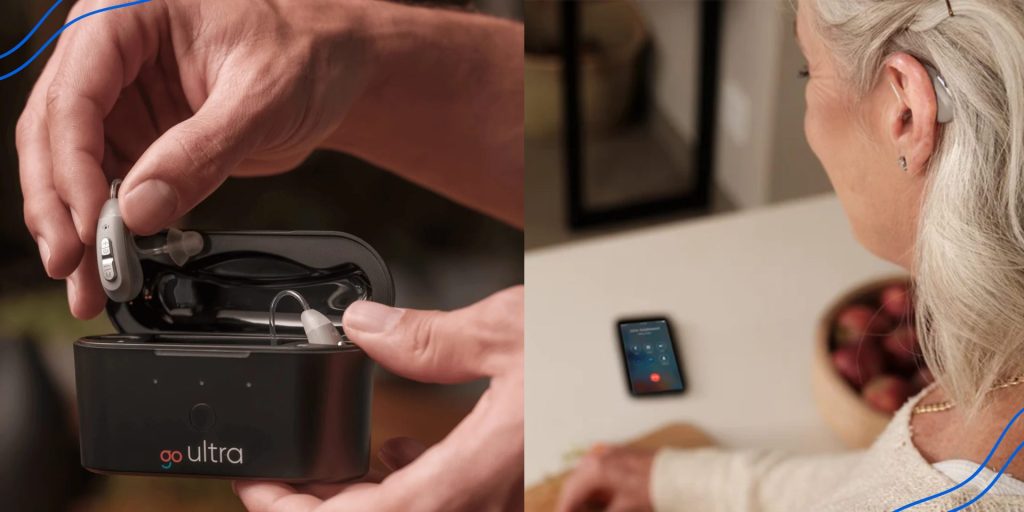
There are three different styles available from Go Hearing Aids. The table below shows a breakdown of the features and benefits of each style: Ultra, Prime, and Lite. All three styles have a 45-day trial period during which you can return the devices and get your money back if you aren’t satisfied, as well as a 1-year warranty for repairs.
| Go Ultra | Go Prime | Go Lite | |
| Style | Behind-the-ear (BTE) | In-the-ear (ITE) | In-the-ear (ITE) |
| Price per pair | $499 | $299 | $169-$199 |
| Rechargeable | Yes up to 20 hours | Yes up to 20 hours | Yes up to 20 hours |
| Sound processing | Digital | Digital | Analog |
| Streaming | Yes | No | No |
| Noise Reduction | Yes | Yes | No |
| Program/volume control | Yes | Yes | No |
| Color | Gray | Black | Black |
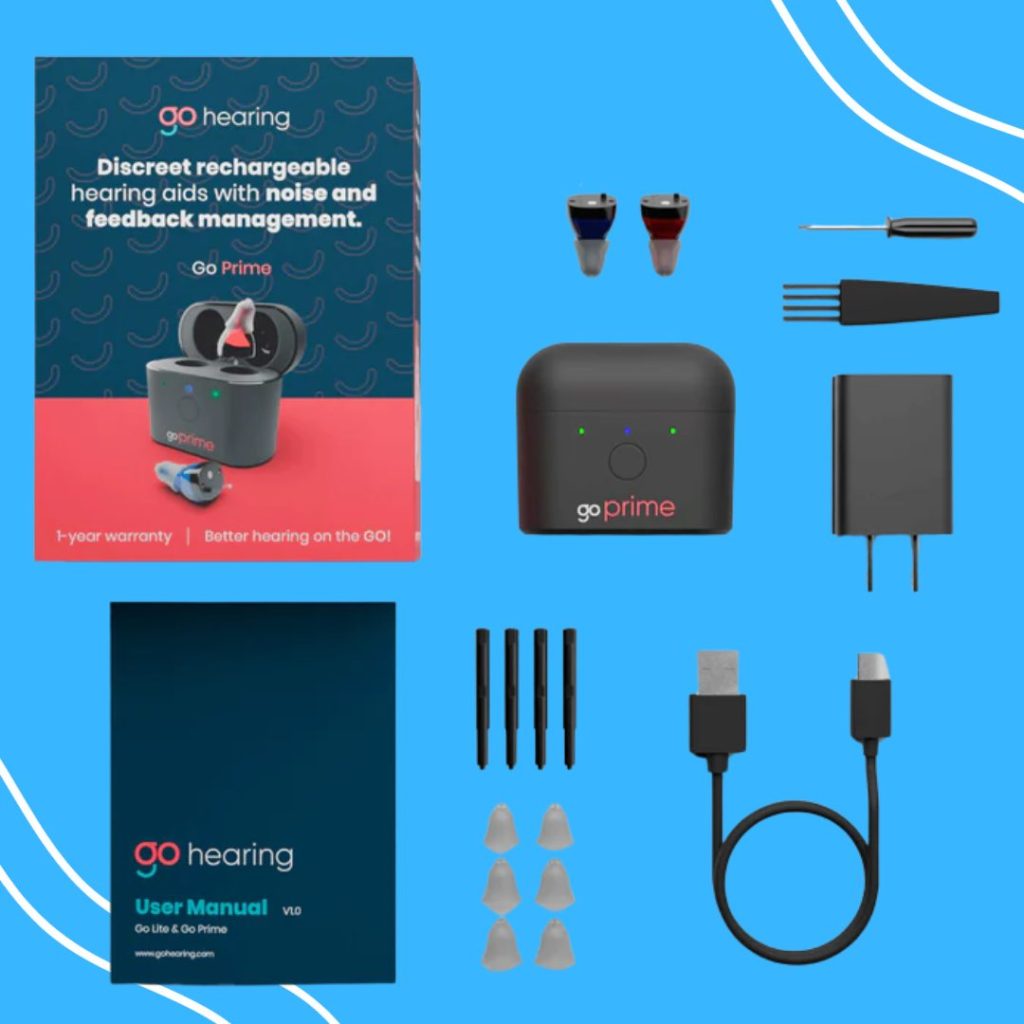
With any of the devices, you can purchase a dehumidifier jar (recommended for all hearing aids) as well as an accessory kit that includes extra domes, wax guards, and cleaning supplies. The hearing aids come in a case that also serves as the charger, with a charging cable and plug.


While many OTC hearing aids utilize an audiogram to customize the amplification based on the individual’s hearing loss, Go Hearing Aids do not have this ability to input an audiogram. They offer three settings: “normal,” “high frequency,” and “low frequency,” with the latter two offering additional emphasis on those frequency ranges that individuals may have more difficulty hearing. Within each program, there are eight volume settings. It is important to note that all OTC hearing aids are only considered appropriate for patients with mild to moderate hearing loss. Greater degrees of hearing loss require a fitting of prescription hearing aids by a licensed audiologist or hearing aid dispenser.
Customer Opinions and Experiences
Like any product, there is a range of positive and negative Go Hearing Aid reviews. Many patients do report good ease of use, ease of insertion, and ability to hold a charge. Naturally, the price point of these hearing aids is also considered to be a great advantage. The affordability of these devices can offer some improved access to sound for individuals who cannot afford traditional hearing aids.
Other users offering Go Hearing Aid reviews report that these hearing aids did not help them with background noise. While the Ultra and Prime models do advertise that they offer some noise reduction technology, it is not going to be as sophisticated as what is offered in higher-end OTC models or traditional prescription hearing aids. Because Go Hearing Aids don’t take the patient’s individual audiogram into account, they are more comparable to personal sound amplification products (PSAPs), which amplify all sounds equally rather than trying to focus on speech. Other critical Go Hearing Aid reviews report that the volume button is tricky to use due to size and placement.
Comparisons with other hearing aid brands
Navigating the hearing aid search when you are on a budget can be quite tricky. Even if you do plan to pursue over-the-counter hearing aids, you should start with a full diagnostic hearing evaluation. This is often covered by insurance, and your provider can help guide you through what might be appropriate in addition to explaining your test results. If you do have mild to moderate hearing loss, as determined by a diagnostic audiogram, you can consider your options for OTC devices. The great thing about the trial period on these devices is that you can try several styles to see what best suits your hearing loss and lifestyle.
The mission of Go Hearing Aids (and hearX in general) to offer affordable hearing healthcare is quite admirable. While the price point does reflect some of the limitations of the technology, the company has excellent customer service, including easy returns and personalized patient support. Go Hearing Aids could be a great starting point to determine whether amplification is suitable for you.
There are recognizable brands of other electronics, such as Jabra, Siemens, and Bose, that make OTC hearing aids with good reviews. Some of the more expensive models more closely approximate prescription hearing aids in that they offer rechargeability, multiple programs, and streaming capabilities. These models also utilize audiometric test results to customize the amplification.
The Jabra Enhance Plus are $799 for a pair, and they are in-the-ear, earbud-style hearing aids comparable to the Go Prime and Go Lite. The Jabra devices are controlled through an app on your smartphone where you are able to stream music and media but also change the preferred listening settings between “Adaptive,” “Focus,” and “Surround Listen” modes. Think of these as similar to the “scenes” that might be included on prescription hearing aids, but without the automaticity and additional options (three compared to 12+, at the higher levels).

Another OTC option is the Lexie B2 by Bose (notably, Lexie hearing aids are also advertised on the hearX page) for $999 a pair. Bose is a well-known manufacturer of headphones and other electronics, and these hearing aids offer manual controls for volume, treble, bass, and microphone directionality via their proprietary app. If you get the settings to a good place in a particular environment, you are also able to save those settings for future use. There is definitely more manual control than automaticity in the OTC hearing aids than prescription hearing aids, but these come at a pretty affordable price point.


Compared to these two popular OTC hearing aids, Go Hearing Aids are considerably less expensive while still offering rechargeability, some streaming options with the Go Ultra device, and digital sound processing with the Ultra and Prime devices. They are missing the customization of being programmed based on the patient’s audiogram and much of the automaticity and noise reduction capabilities available in other OTC devices and prescription hearing aids. The battery life is reasonably comparable to other rechargeable devices, ensuring a full listening day’s use.
Conclusion
It is very important to find a balance between affordability and performance when choosing hearing aids. The first step is always to obtain a full diagnostic hearing test from a professional before pursuing any type of amplification. That individual can help guide you through what devices might be appropriate based on your degree of hearing loss. If you choose to pursue OTCs rather than prescription devices, you will be doing so with some information about your hearing loss and what traditional aids and providers can offer you.
Hopefully, this Go Hearing Aid review has been helpful in determining whether they might be appropriate for you to try. If not, please consult our Hearing People page for many more reviews of other OTC and prescription hearing aid devices available for all degrees of hearing loss and lifestyles.

Erin Edwards received her Doctor of Audiology degree from Towson University in 2015 and her Ph.D. in Education and Leadership from Pacific University in 2022. She has worked with patients of all ages in a variety of settings and has a specific interest in cochlear implants, the relationship of hearing loss and dementia, and interdisciplinary healthcare.